Welcome to the Mathematical World!
Calyampudi Radhakrishna Rao
Architect of Modern Statistical Theory
Calyampudi Radhakrishna Rao (September 10, 1920 – August 22, 2023), widely known as C. R. Rao, was one of the most influential statisticians of the 20th and 21st centuries. Born in Huvvina Hadagali, India, he displayed early brilliance in mathematics and went on to study at Andhra University, graduating with distinction in 1940. He later pursued a master’s degree in statistics at Calcutta University, where he worked under P. C. Mahalanobis at the Indian Statistical Institute (ISI). This formative period shaped his career, laying the foundation for his groundbreaking contributions to mathematical statistics, probability, and data science.
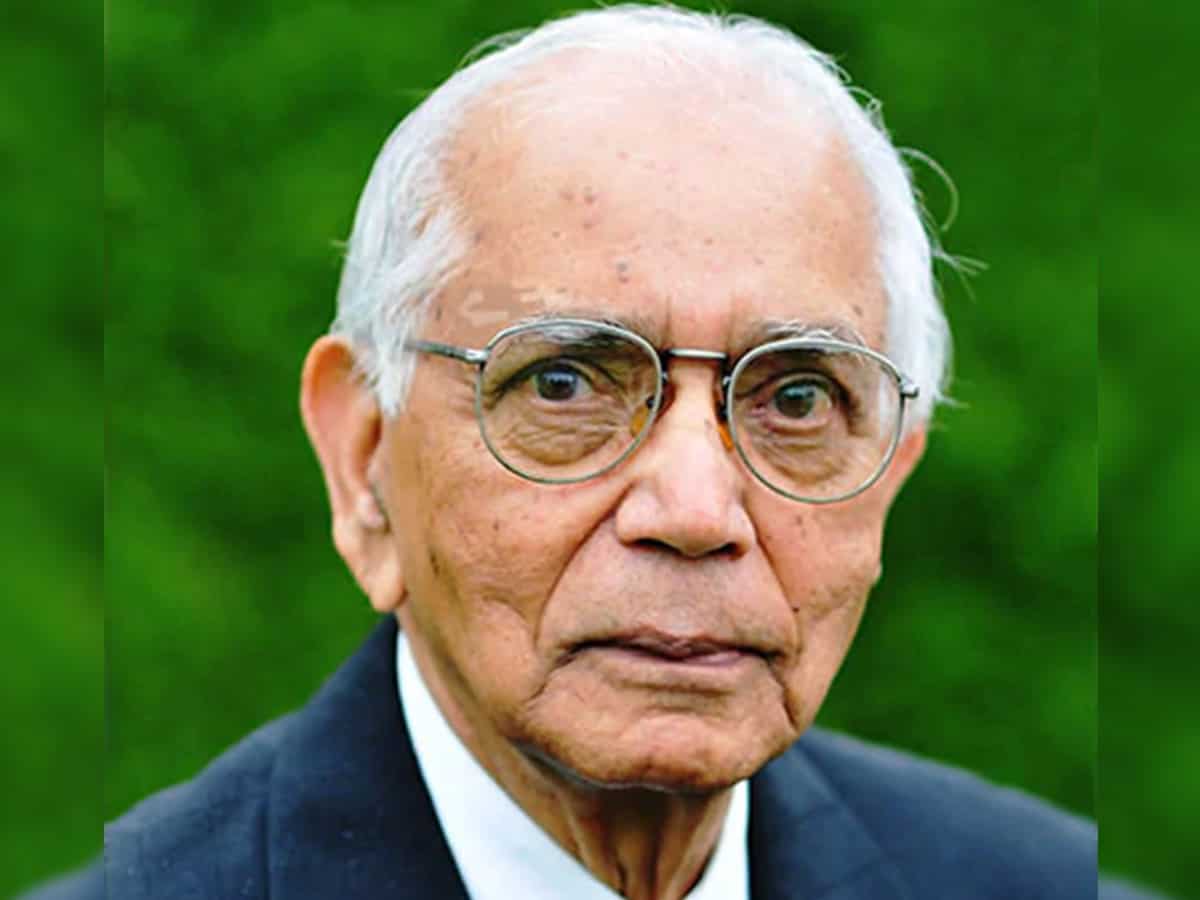
Rao’s contributions transformed statistical theory. His most celebrated result is the Cramér–Rao inequality, which provides a lower bound on the variance of unbiased estimators:
\[ \text{Var}(\hat{\theta}) \geq \frac{1}{I(\theta)} \]
where \( I(\theta) \) denotes the Fisher information. This bound is central in statistical inference, as it defines the theoretical efficiency of estimators. Equally important is the Rao–Blackwell theorem, which demonstrates that any unbiased estimator can be improved by conditioning on a sufficient statistic, leading to more efficient results. Rao also pioneered orthogonal arrays, now fundamental in the design of experiments, quality control, and industrial applications. His work extended into multivariate analysis, biometrics, and even differential geometry applied to statistics.
Beyond research, Rao’s leadership shaped institutions and future generations of statisticians. He served as director of ISI (1964–1972) and later held distinguished professorships at universities in the United States, including the University of Pittsburgh and Penn State. His influential book Linear Statistical Inference and Its Applications became a classic, shaping global statistical education.
Rao’s achievements earned him international recognition. He received the U.S. National Medal of Science (2002) and, in 2023, shortly before his passing, the International Prize in Statistics, often considered the “Nobel Prize of Statistics.” His work impacted diverse fields—economics, genetics, geology, demography, machine learning, and beyond.
C. R. Rao passed away at the age of 102, leaving behind over eight decades of scholarship. His legacy lies not only in elegant theorems but also in their profound practical influence. His results remain indispensable to statisticians and data scientists, marking him as one of the greatest architects of modern statistical thought.

All rights reserved by the Mathematical Unity
Contact: +8801400044645
Email: mathematicalhorse1453@gmail.com
Our Discord Server: Mathematical Unity [Ulus Riyadiyat]